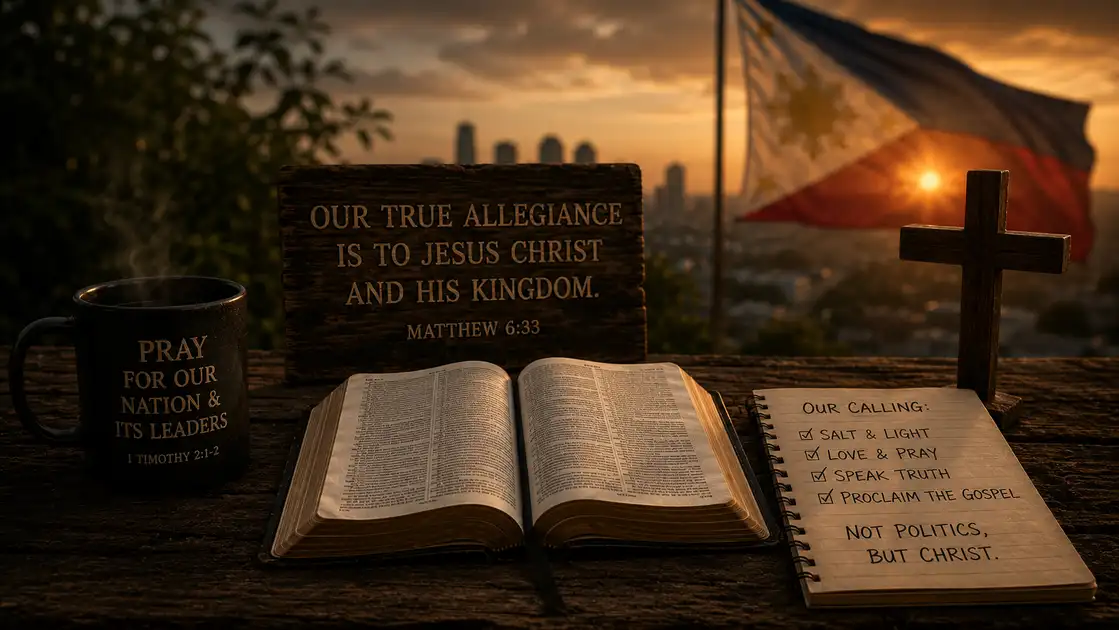
When we listen to the news, especially about politics, instead of praying for our nation, its leaders, and the salvation of their souls, we can easily end up hating them and saying things that a Christian should not say.
That is precisely why I dislike politics: it can so easily corrupt our Christian values. It grieves me when Christians—even pastors, elders, or leaders—speak about politics to the point where they no longer sound like followers of Christ. They discuss politics from a purely human perspective, like people on the streets or in barbershops, rather than as believers who firmly adhere to Christian values and maintain an absolute allegiance to the Lord Jesus Christ in their character, conduct, and speech.
As Christians, our primary calling is to be the salt and light of the world—not conforming to the world or being corrupted by it, but living out and sharing Jesus’ teachings. As citizens, instead of participating in the dirty games of politics, spreading hateful messages, or sharing fake news, we should remain holy and set apart for God’s work—specifically, spreading the Gospel and teaching everything Jesus commanded us.
When we watch or listen to the news, the benefit should not just be staying informed about our nation; rather, that awareness should drive us to intercessory prayer, knowing that God is ultimately in control. This approach keeps us focused on our main tasks as Christians: to follow Christ in character and conduct, remaining non-partisan while praying for our nation's leaders and their souls.
As Filipino citizens, we have a duty to participate in the transformation of our nation because we are part of it. We can only be effective in this if we align with God's standards and Jesus’ teachings in the Bible. By teaching the current and future generations to serve the Lord, we can build a transformed nation—free from corruption and oppression—because they will grow up with the fear of the Lord.
Our support for our preferred politicians should never supersede or compromise our Christian values. After all, all authorities are under Jesus Christ, and all must ultimately submit to Him. Instead of being die-hard supporters, we should strive to be fair, seeking the truth and justice that are pleasing in the eyes of God.
Instead of joining the crowd in slinging mud and spreading hateful messages about the current administration, why not intercede for their souls? After all, we are called to spread the Good News so that those who hear it may be saved. Beyond prayer, the legal way we can participate in positive change is by exercising our right to vote, asking God for the wisdom to choose leaders who will truly help build the nation.
The goal of an election is that the next time we check the news on TV or social media, we will see good news—stories that stir up our patriotism and restore our trust in government. We want to avoid the constant stream of bad news that tempts us to compromise our Christian character and conform to the patterns of a politically charged world. This positive shift is possible when we elect the right people to serve the country. Elected officials are not our bosses; they are servants of the country and its people, hired through our votes. Our only true Master is God alone. Blessed is the nation whose God is the Lord.
Our political opinions should never become our core identity or corrupt our calling to be Christlike. Instead, our Christian values should be the lens that shapes our political views.
“What joy for the nation whose God is the Lord, whose people he has chosen as his inheritance.” — Psalm 33:12 (NLT)
"Blessed is the nation whose God is the Lord, the people he chose for his inheritance." — Psalm 33:12 (NIV)