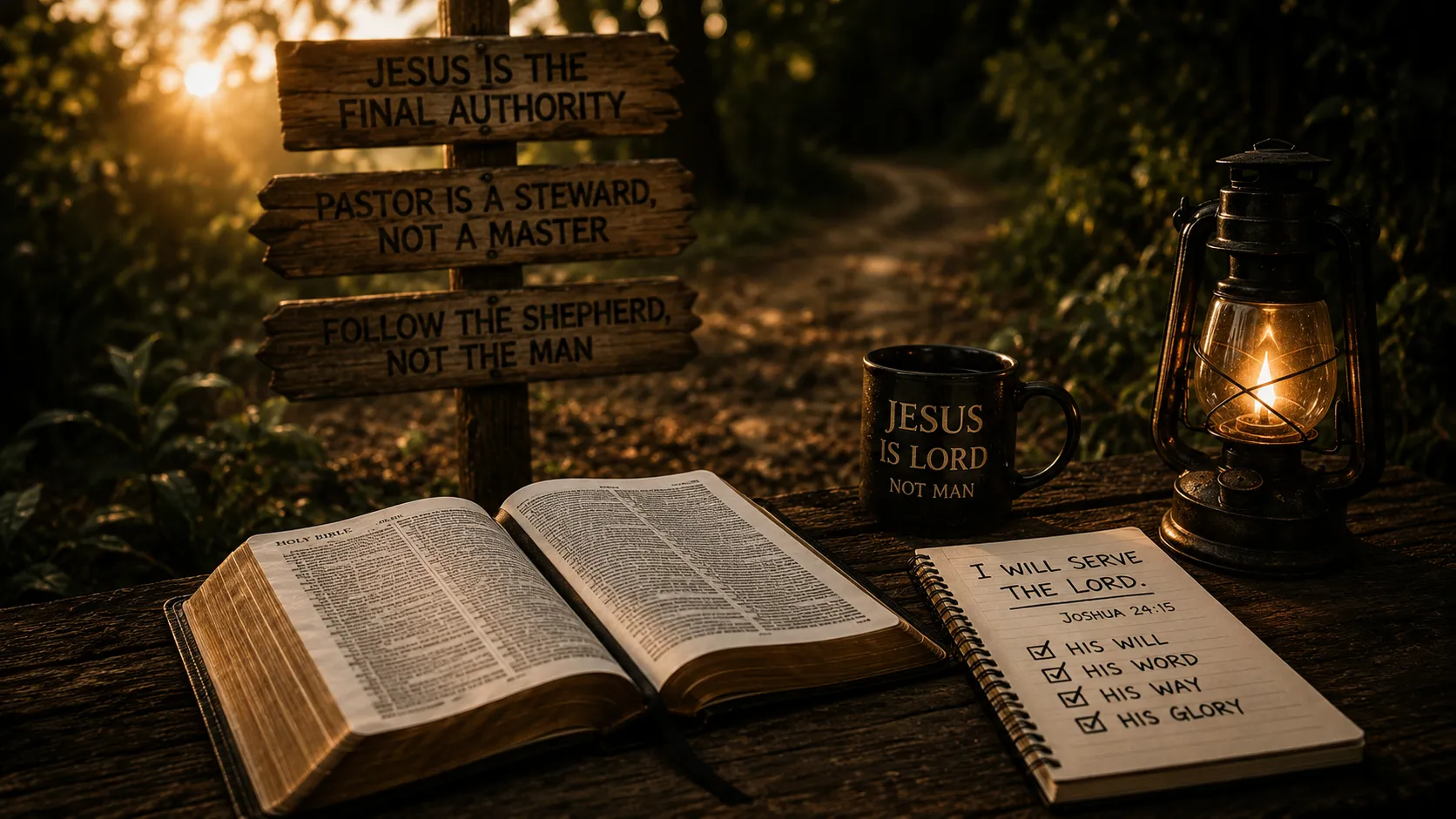
The pastor is not the final authority; Jesus is. Though pastors have authority given by Jesus, they should not act beyond the limits of that authority. Their role should never supersede the authority of Christ, because all authority is under Him. A pastor must lead, not as a master, but as a steward, guiding the sheep to the Shepherd. Pastors should not cause others to stumble in their faith or commit sin by forcing them to choose between their own will and God’s will, especially when the two are in conflict.
If a pastor insists on imposing their will on others, it could be a sign of ego, exalting themselves above others, and even above God. Or, perhaps, they are simply confused about what truly aligns with God's will according to His Word. Not everything we do "for the Lord" is pleasing to Him. Remember the story of King Saul.
As for me, I will serve the Lord. Don’t get me wrong: when I say this, I mean I will only follow my own will or the will of others (even pastors or elders) if it aligns with the will of the Lord and does not contradict His Word. Otherwise, I would become a people-pleaser, sinning by choosing to please others over pleasing God, engaging in actions that God detests.
Do I deliberately want to rebel against church leaders and pastors? Absolutely not. As long as they follow the will of the Lord and do not twist it, I will gladly follow them. But if they deviate from it, I will not. I will join them in obedience to the Lord, but not in rebellion. While I respect their authority, my loyalty is to the Lord and His Word, even if that loyalty costs me my life or makes others hate me. After all, I would not be a worthy disciple of Christ if I chose to please them over Jesus.
Because my loyalty is to Jesus, I am not loyal to myself or my own desires. Even if I don’t like what’s required of me, if it is His will, I will submit. Even if I dislike the words I hear, whether they come from a pastor, church leader, fellow believer, or even someone outside the faith, I will accept them humbly if they are from the Lord.
We must not place our devotion in pastors or leaders as though we are worshipping them. Worship belongs to God alone. Pastors are servants sent by God to lead people back to Him, not to draw worship to themselves. This is just as God instructed Moses to lead the Israelites to the Promised Land to worship Him, not Moses.
Pastors and church leaders must not assume that they enjoy spiritual immunity, using the hand of God against their "enemies," even if those enemies are simply people who oppose their twisted principles. God’s hand acts according to His justice and Word, not according to their will and justice. We must not use it abusively or recklessly to serve our own agendas, forcing others to agree with personal stances that are not in line with the Lord's will.
If someone says I am “reaping what I sow” because I have suffered for speaking out against pastors or church leaders, so be it. I would rather suffer like the apostles, early Christians, and the believers in the book of Acts than stay silent out of fear, whether it is the fear of death, making enemies in the church, or losing my blessings. I refuse to renounce my loyalty to God and my desire to please Him. I will not be ashamed of the Gospel, even if it means questioning what is not from God.
In the end, we must choose whom we will serve: ourselves and our own agendas, flawed leaders and pastors, or God, who created us, gives us life, and has the power to destroy both body and soul.
When you begin to have a personal relationship with God, your motivation for serving Him goes beyond the fear of hell. Even our works for God can become a source of pride if we boast in our accomplishments. But God looks beyond appearances; He looks at the heart. For example, King Saul disobeyed God’s specific instructions given through Samuel, and because of that, the Lord rejected him. As Samuel said, "Obedience is better than sacrifice."
Jesus taught that before offering our gifts, we must reconcile with our brothers and sisters. Therefore, even our offerings become meaningless if we harbor hatred or sin in our hearts, or anything else that displeases God. Jesus also teaches and commands us to love our enemies and to forgive. We must obey this, just as we obey other commandments regarding tithes and offerings.
The point is this: You cannot truly serve God to the point of death simply because you feel obligated or because others told you it is the right thing to do. You must count the cost of following Christ. You must think deeply about what you may need to give up. If there is anything you value more than Him, such as your pride, relationships, or even blessings, you must choose: give it up, or give up Christ.
You cannot follow Jesus if you are unwilling to let go of your pride, whether you are a church member, a leader, or a pastor. Following Him requires humility, correction, discipline, and sometimes, losing friends, being betrayed, or even experiencing loss as a test of faith.
If you’re not willing to surrender all these things, you will not be able to serve the Lord with your whole heart, in alignment with His will and Word.
We also cannot force others to stand for the Lord, to face persecution, or to die for their faith if their hearts are not wholly devoted. A person will only endure such sacrifice if they have already chosen to give up everything to gain Christ.
That kind of surrender is only possible with God. As Jesus told His disciples after the rich man walked away:
"Humanly speaking, it is impossible. But not with God. Everything is possible with God." (Mark 10:27, New Living Translation)
What seems impossible, such as giving up everything to enter the Kingdom, is made possible by God's grace and power. Our salvation doesn’t come through human effort, wealth, or social status, but through faith in Jesus and what He did for us on the cross.
It is also God who gives us the desire to give up everything and follow Jesus, along with the power to do it. This was the very power the rich man lacked, because he tried to gain eternal life through his own efforts, without the help of God, who gives us both the desire and the power through His Holy Spirit:
"For God is working in you, giving you the desire and the power to do what pleases him." (Philippians 2:13, New Living Translation)